Sources:
Albert Farrington, It’s a Long, Long Way to Tipperary (1915) a, 00:00:00 <http://archive.org/details/AlbertFarrington>
Curtayne, Alice, Francis Ledwidge: A Life of the Poet (New Island Books, 1972)
‘Easter Rising | National Army Museum’ <https://www.nam.ac.uk/explore/easter-rising>
‘Easter Rising 1916 | National Army Museum’ <https://www.nam.ac.uk/schools/learning-resources/easter-rising-1916>
‘Explainer: What Was the Easter Rising? | Century Ireland’ <https://www.rte.ie/centuryireland/articles/what-was-the-easter-rising>
‘Francis Ledwidge Museum’ <http://www.francisledwidge.com/>
‘Irish War Poets’, Never Such Innocence <https://www.neversuchinnocence.com/irish-war-poets-first-world-war>
Jones, Nigel, Rupert Brooke: Life, Death and Myth (Head of Zeus, 2001)
Korda, Michael, Muse of Fire: World War I as Seen Through the Lives of the Soldier Poets (Liveright, 2024)
Ledwidge, Francis, Complete Poems. With an Introd. by Lord Dunsany (London H. Jenkins, 1919) <http://archive.org/details/completepoemswit00ledwuoft>
———, Songs of the Fields (New York : Duffield, 1916) <http://archive.org/details/songsoffields00ledwiala>
Mondays at the Mess: ‘Francis Ledwidge, His Life and Works’ by Liam O’Meara, dir. by Dublin City Council Culture Company, 2022 <https://www.youtube.com/watch?v=LfCp5WfHqqY>
‘Rupert Brooke (1887 – 1915) – The War Poets Association’ <https://warpoets.org/conflicts/great-war/rupert-brooke-1887-1915/>
‘Rupert Brooke on Skyros’ <https://www.rupertbrookeonskyros.com/Intro.htm>
Ruzich, Connie, ‘Behind Their Lines: It Is Terrible to Be Always Homesick’, Behind Their Lines, 2014 <https://behindtheirlines.blogspot.com/2014/11/it-is-terrible-to-be-always-homesick.html>
‘Salonika Campaign | National Army Museum’ <https://www.nam.ac.uk/explore/salonika-campaign>
‘The Project Gutenberg eBook of The Complete Poems, by Francis Ledwidge.’ <https://www.gutenberg.org/files/53621/53621-h/53621-h.htm>
Transcript:
Daragh: [00:00:00] War. Darkness and I are one, and wind and nagging thunder brothers all. My mother was a storm. I call and shorten your way with speed to me. I am the love and hate and the terrible mind of vicious gods, but more am I. I am the pride in the lover’s eye. I am the epic of the sea.
Hello. I’m Ashton Kessler, also known as The Magpie Historian. I’m a master’s student and a public historian. This is Soldiers of Dust, a podcast dedicated to exploring the poetry of The Great War. Over the next episodes, we will discuss the poets, their work, and the way that it shaped how we view the war in the present day.
I hope you’ll join me on this journey.
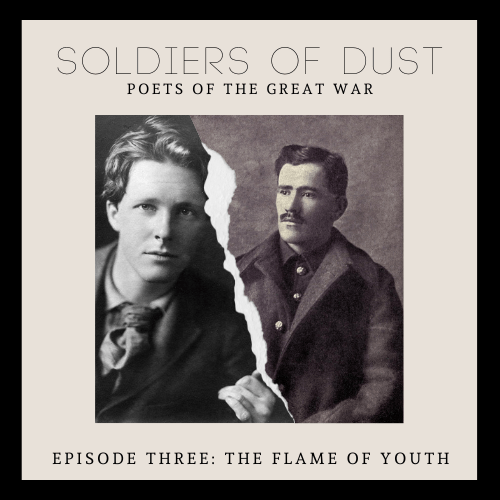
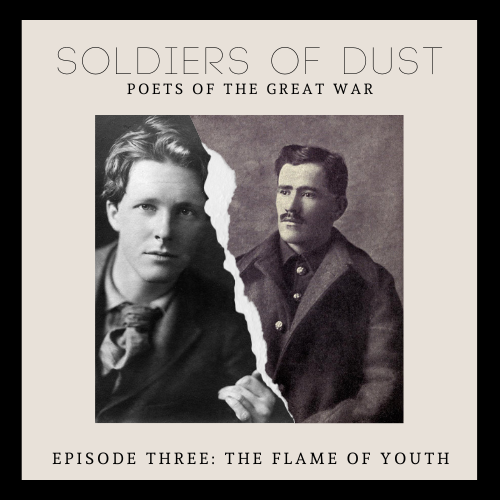
Our episode, the flame of youth will talk about two very different poets, one English and one Irish [00:01:00] but who both fought for the British army. Rupert Brooke is known for being the poster child of patriotic sonnets who died young and beautiful. Frances Ledwidge is a lesser known poet, but an important one for the understanding of the Irish role in the great war.
Before we begin our episode, I would like to remind listeners that the subject matter may be distressing and possibly triggering as this podcast is ultimately about the effects and trauma of war. Other themes that we will cover, such as anti-semitism, classism, sexism, xenophobia, and homophobia can also be a cause for upset.
So please be aware of this while listening. .
Roland: Blow out, you bugles, over the rich dead. There’s none of these so lonely and poor of old, but dying has made us rarer gifts than gold. [00:02:00] These laid the world away, poured out the red sweet wine of youth, gave up the years to be of work and joy, And that unhoped serene that men call age, And those who would have been their sons, They gave their immortality.
Blow, bugles, blow! They brought us, for our dearth, Holiness lacked so long, and love, and pain. Honour has come back, as a king, to earth, And paid his subjects with a royal wage. And nobleness walks in our ways again, And we have come into our heritage.
Ashton: Rupert Chawner Brooke was born in Rugby, Warwickshire, on the 3rd of August, 1887. He was the third of four children born to Willie Brooke, a schoolmaster, and Ruth Cotterell, a school matron. Rupert attended Hillbrow [00:03:00] Preparatory School before going to Rugby school. Rugby was known as the birthplace of, you guessed it, rugby football, and was memorialized in the novel Tom Brown’s School Days by Thomas Hughes.
Rupert had no problem fitting in and was a natural athlete who excelled in cricket and rugby. He had a difficult relationship with his mother, who was domineering and demanded him to fall in line with what she wanted. He was charming and beautiful, which allowed him a certain level of privilege, especially when it came to the attention of women.
He attended King’s College, Cambridge, in 1906 on a scholarship to study classics. He struggled to fit in at first, but things changed after joining the amateur dramatic club and performing in a non speaking role. His social circle opened up and he became more involved in extracurricular activities like writing for the Cambridge Review, which published one of his poems.
Sadly, his eldest brother Dick died of pneumonia in 1907 at age 26, and despite his offers to come home, his parents insisted he [00:04:00] stay on at school. He continued to write poetry and joined a secret society called the Apostles. Though his first year was not an academic success, he made his own plays at Cambridge.
In a second year, he continued to be part of the Apostles, but also became politically aware by joining a group of socialists called the Fabian Society. He eventually switched his subjects to English literature, which suited him much better. He became friends with Edward Marsh, an important literary connection.
Aside from his intellectual and social life, his love life became more and more complicated. While Rupert was beautiful and charming, he was also emotionally volatile and sexually frustrated. Despite being agnostic, the lasting effects of sexual repression from his Victorian upbringing had a hold on him.
He developed an intense crush on 16 year old Noel Olivier, who was far too mature and level headed, to take his anguished declarations of love seriously. Noel was one of four sisters, one of whom Rupert also had a brief interest in. Aside from Noelle was his [00:05:00] friend Katherine Laird Cox, nicknamed Ka, who was a member of the Fabian Society at Cambridge.
She was gentle and kind, and mothered Rupert through his emotional crises. He also had a sexual experience with another man in 1909, which he later wrote about in detail to a friend. His visit to Munich in the summer of 1911 improve his German included meeting Élisabeth van Rysselberghe, a Belgian woman who was the daughter of neo-impressionist painter. Their fling cooled rather quickly, but they continued write letters to one another. Rupert returned to England to enjoy the rest of the summer before returning to Cambridge. Over the autumn and winter of that year, Rupert became stuck in a romantic mess of his own making. By the time he realized he had feelings for Ka , she had already moved on to Henry Lamb, a more experienced man who made Rupert feel inferior in every way.
Things came to a head over the Christmas period when Ka, and Rupert finally had it out. She was in love with Lamb and Noel was being pursued by someone else, which he had to accept. In the new [00:06:00] year of 1912, he was sent to London to see a psychiatrist due to his anguished state, and was diagnosed as having a severe nervous breakdown.
To quote Michael Korda from his book Muse of Fire, ” Brooke’s ongoing seesaw between homosexual and heterosexual impulses, his love hate relationship with his dominating mother, the war between his Puritan instincts and his own desires, his disgust at female eroticism once he had aroused it, his heightened sensitivity as a poet. None of these touchy issues were explored,” instead his doctor judged that he was overworked and too introspective for his own good, and would need to rest. After convalescence with his mother in France, he went to Germany to meet up with Ka. He’d sent her countless letters while he’d been recovering, and most likely, feeling guilty, Ka agreed to meet him. The two shared a brief tryst, which only further exacerbated Rupert’s ideas of female agency and misogynistic ownership.
He went to Germany and wrote one of his most famous poems, “The Old Vicarage, Grantchester”, in a [00:07:00] cathartic moment during his mental breakdown, which had plagued him.
He prepared poems to be printed in Edward Marsh’s Georgian Poetry and worked on his thesis, which he hoped would earn him a fellowship. At this point, Rupert was craving change, and so with Marsh’s help, he prepared to travel to America, Canada, and Polynesia to write some travel pieces for The Westminster Gazette in 1913.
He spent the year experiencing other cultures, having a few love affairs, and writing poetry. In some ways, it seemed he had finally become a grown up.
Francis “Frank” Edward Ledwidge was born on the eastern edge of Slane, County Meath, Ireland on the 17th of August, 1887. He was the eighth of nine children born to Patrick Ledwich and Anne Lynch. His parents were determined to give their children a good education. Sadly, his father died when he was only five years old.
His eldest brother, also called Patrick, had to sacrifice going to college to become the breadwinner for the family. Anne herself made do with working in the [00:08:00] fields, picking crops, and in the winter, she knit socks, did laundry, and mending. They were also helped along by neighbors in their community. Frank left school at 13, and though he told people he had left because he had nothing else to learn, it really was due to needing to help ease the financial burden on the family.
He worked on a neighbor’s farm and as an apprentice in nearby Drogheda. He was tall and strong and known for his mischievous sense of humor and penchant for rhymes. At 15, he went to Dublin to take over his brother’s apprenticeship at a grocery store, but he hated the city and was home sick for Slane. He wrote a poem one night, “Behind Closed Eye” about the place he missed so much.
Daragh: Behind the closed eye I walk the old frequented ways That wind around the tangled braes I live again the sunny days ere I the city knew And scenes of old again are born The woodbine lassoing the thorn And [00:09:00] dropping ruth like in the corn The poppies weep the dew Above me in their hundred schools The magpie bend their young to rules And like an apron full of jewels The dewy cobweb swings And frisking in the stream below, the troutlets make the circles flow, and the hungry crane doth watch them grow as a smoker does his rings.
Above me smokes the little town with its whitewashed walls and roofs of brown, and its octagon spire toned smoothly down as the holy mines within. And wondrous, and prudently sweet, Half him passion, half conceit, The blackbird calls it down the street Like the piper of Hamelin. I hear him, and I feel the lure Drawing me back to the homely moor.
I’ll go and close the mountain’s door On the city’s strifin din.
Ashton: It had only been a few days, but Frank was ready to go home, and so he left in the middle of the night. The road from Dublin to Slane is one of the straightest roads in Ireland, supposedly due to the orders of King George IV, so he could [00:10:00] visit his mistress, Lady Conynghams, at Slane Castle. Frank walked 30 miles back to Slane, counting the miles as he went.
Frank stayed close to home by working as a yard boy, a farmer, road worker, and copper miner. He and his younger brother, Joe, lived at home and supported their mother, allowing her a more comfortable life. Frank’s interest in poetry continued with his work being published in The Drogheda Independent.
At age 25, he developed an unlikely friendship with Edward Plunkett, 18th Baron Dunsany, who was a writer and dramatist. In 1912, he sent him a notebook of poems with a covering letter asking if there was any merit to them. After a few weeks of no response due to his being in London, Dunsany wrote back a friendly and encouraging letter agreeing that he was a true poet.
Dunsany had been raised in Kent, attended Eton and Sandhurst, and fought in the Boer War. He was generous and kind, inviting Frank to visit him and to use the library at [00:11:00] Dunsany Castle whenever he liked. He taught Frank everything he knew about writing and edited his poems. Their friendship caused a bit of a stir in the local community, with Frank becoming a minor celebrity.
His mother would be stopped during her usual errands to ask how Frank was doing, and she would have to make up news to satiate their curiosity. That fall, he fell in love with Ellie Vaughey, a family friend, but she broke things off due to their class differences. Ledwidge had no prospects and worked as a road man while Ellie came from a more prosperous family. Determined to prove his worth to Ellie, he procured a job as a clerk for the Meath Labor Union, at nearby Naven, hoping it would help him establish a career. Instead, Ellie married someone else, and a year later she died after giving birth to a daughter. Despite the ending of their relationship, Frank wrote a poem upon hearing of her death titled “To One Dead”, which chronicled the love he still had for her. It was one of many poems he wrote about Ellie.
In the summer of 1914, after returning from his [00:12:00] travels abroad, Rupert Brooke was introduced to Siegfried Sassoon by Edward Marsh. The two young men were only a year apart, both Cambridge attendees of similar pedigree, and yet, Rupert had reached the level of success that Siegfried was yet to. Strangely, they would be famous for their vastly different experiences of war in the coming years. Brooke’s poems from his time in the South Seas had made him a much sought after dinner guest, and he was beginning to think about settling down and getting married. Who he would marry was a different question, as his previous paramours had moved on. However, there was also the issue of the breakout of war, and the role that Britain would assume in the conflict. One day before his 22nd birthday, he asked Edward Marsh for help in getting a job either in fighting or war correspondence.
Winston Churchill, a close friend of Marsh’s, commissioned Brooke himself as a sub lieutenant in the Royal Navy. By the fall, he was a soldier kitted out in uniform and practicing drills. It was at that point that he wrote his poem, “Peace”.
Roland: [00:13:00] Now, God be thanked, who has matched us with this hour, And caught our youth, and wakened us from sleeping, With hand made shore, clear eye, and sharpened power, To turn, as swimmers, into cleanness leaping, Glad from a world grown old and cold and weary, Leave the sick hearts, that honour could not move, And half men, and their dirty songs and dreary, And all the little emptiness of love.
O we who have known shame, we have found release there, Where there’s no ill, no grief, but sleep has mending, Naught broken save this body, lost but breath, Nothing to shake the laughing heart’s long peace there, But only agony, and that has ending, And the worst friend and enemy is but death.
Ashton: As Brooke highlights, war was an [00:14:00] adventure for men of a certain age. There was excitement and pride in being able to defend their country. The popularity of his war poetry at the time was because he excelled at illustrating the national mood, one of expected triumph. To die for one’s country would be, to quote J. M. Barrie, “an awfully big adventure”. He was stationed in Antwerp, which turned out to be a baptism by fire when the Germans bombarded the city with heavy artillery. Antwerp was taken by the Germans and the city was evacuated. Rupert’s battalion was taken back to the UK. Over the winter, he was assigned to a new company, and though he fell ill with laryngitis and was doing countless drills in the rain and mud in Dorset, he wrote to a fellow poet, “Come and die, it will be great fun.”
In mid February, he departed with his ship to take part in the Gallipoli campaign. After a failed attempt at opening the Dardanelles, a narrow waterway off Gallipoli, he went to Egypt for training. While Brooke was ill from sunstroke in the desert, his poem, “The Soldier”, was read aloud during the Easter [00:15:00] service at St. Paul’s Cathedral. His popularity and fame had reached a new high as people responded to the patriotic symbolism of his poetry. Perhaps in the most strangely poetic way for a man who studied classics, Rupert died in a bay off the island of Skyros. His fleet had been delayed in Egypt before they headed to Greece.
A mosquito bite he had had become swollen and infected, leading to septicemia. Despite the efforts of doctors on board the medical ship, he died quietly at 4. 46 pm on the 23rd of April 1915 at 27 years old. He was buried in an olive grove on the island.
Frank Ledwidge was a member of the Irish Volunteers, an Irish paramilitary group who supported Ireland’s independence from Britain’s rule. There were disagreements amongst the group about supporting the British in their response to the War or remaining neutral. Frank was a proud Irishman, but the question remained that if Britain lost, then what would happen to Ireland?[00:16:00]
He said, “I joined the British Army because she stood between Ireland and an enemy common to our civilization, and I would not have her say that she defended us while we did nothing at home but pass resolutions.” He was still smarting from Ellie’s new relationship and wished to leave Slane, and the war was supposed to only last a short time.
He joined the Royal Inniskilling Fusiliers on the 24th of October, 1914, and was sent to Richmond Barracks in Dublin. His regiment was the closest to all-Irish that he could get, and his friend Lord Dunsany was a member. Frank fit in easily, and his experience with the Volunteers had given him a leg up in his standing with the army, and he was promoted to Lance Corporal. In the spring of 1915, his division was sent to Basingstoke to mobilize before going to France. He and Dunsany continued to work on writing while stationed there. Frank’s first book of poetry, Songs in the Field, was due to be published soon . Shortly before being shipped out, Dunsany was reassigned to train soldiers in Derry, taking away one of the only pieces of home Frank [00:17:00] still had. While Rupert Brooke never made it to Gallipoli, it was Frank Ledgwidge’s first experience of war.
Brooke’s death had given the expedition an air of tragic heroism. He was among the 118, 000 men who were evacuated from the peninsula after the campaign failed. While the British army was struggling in the field, Ledwich was experiencing success with his poetry. Songs of the Field got rave reviews and brought him the attention of Edward Marsh.
Marsh included three of his poems in the second volume of Georgian Poetry. Other volumes included the works of some familiar names to our listeners; Rupert Brooke, Robert Graves, Isaac Rosenberg, and Siegfried Sassoon. He was then stationed in Serbia during the fall, but the soldiers were unprepared for the harsh winter, so they were forced to retreat.
During the journey, he had nearly reached camp when he collapsed due to pain caused by an inflamed back. He was sent to five hospitals over the next few months before being sent to England for treatment by a kind doctor who liked his work. He was in Manchester General Hospital [00:18:00]when he heard the news of the Easter Rising of 1916, an armed insurrection by Irish Republicans. The volunteers believed in the old adage, “England’s difficulty is Ireland’s opportunity”. It was their chance to seize an opening and demand independence. Sixteen volunteers were executed for their part in the rebellion, including Thomas McDonagh, a poet and friend. It was a climactic point not just for Ireland, but Ledwidge himself.
He spent the summer writing poetry and preparing his second volume for publication. He had become disillusioned with the British army, and the trauma of war and loss was still too painful to acknowledge in the way that other poets would.
After recovering from his injury, he was sent back to the Western Front after Christmas. He experienced a bleakly cold winter and spring before the summer in Belgium changed suddenly. The heat dried out the trenches and turned the mud into dust. He’d hoped to go on leave to see his family in his beloved Slane again, but all leave had been cancelled as they prepared for the Battle of Ypres. On the 31st of [00:19:00] July, 1917, Ledwidge and his battalion were in the reserves working to lay down road. A summer storm had drenched everything, but they continued working. The men had stopped to have some tea when a shell exploded next to them, killing him and five others instantly. His second collection of poems, Songs of Peace, was already drafted for publication at the time of his death.
Rupert Brooke and Frances Ledwidge were born 16 days apart in different countries and in different circumstances. Aside from their poetic talents and fighting in the First World War, they have little in common. Rupert Brooke’s legacy has been that of one who was forever remembered as beautiful and young. He is the ultimate version of the glorious dead. His poems recall a time when fighting and death was the most a man could achieve. While his poetry has faded out of fashion in the wake of other more brutal poets, his innocence is a key part of understanding the grave underestimation of what would happen during the war.
Frank Ledwidge, on the other hand, is not a traditional war poet, but a [00:20:00] person who found beauty in nature even in times of war. His prose is mired in the Irish ethos and a dedication to a love of his birthplace. In such brief words, he was able to both tell a story and devastate the reader. Like in a letter he wrote of his first experience of war, saying, “Again a man on my right who was mortally hit said: ‘It can’t be far off now,’ and I began to wonder, What it was that could not be far off. Then I knew it was death, and I kept repeating the dying man’s words, ‘ It can’t be far off now.’”
Brooke wrote in his poem, “I loved you before you were old and wise, When the flame of youth was strong in your eyes”. Both Brooke and Ledwidge would never reach the age of being old and wise, forever immortalized as youthful flames snuffed out too soon by the viciousness of war.
And so I leave you with a reading of Francis Ledwidge , “Home”, a poem he wrote in July 1917, in a moment of calm during warfare.
Daragh: [00:21:00] Home. A burst of sudden wings at dawn. Voices in a dreamy noon. Evenings of mist and murmurings. A night with the rainbows of the moon. And through these things a woodway dim and waters dim and slow sheep seen. On uphill paths that wind away through summer sounds and harvest green. This is a song a robin sang this morning on a broken tree.
It was about the little fields that call across the world to me.
Ashton: Thank you for listening to this episode of Soldiers of Dust. You can find sources, transcripts, and contact information on my website, themagpiehistorian. com. Special thank yous go to Roland Allen and Daragh Gilroy for reading Rupert Brooke and Frances Ledwidge’s poetry this episode and as always, to my advisor, Dr. Edward Madigan, for his support. If you like the podcast, please let us know by rating and reviewing us on the platform of your choice. We hope you’ll join [00:22:00] us again in the future. I’ll see you next time.
 Ashton Kessler
Leave a comment