
Sources:
Amaral, Marina, ‘Siegfried Sassoon: A Poet’s Journey Through The Great War’, The Colour of Time with Marina Amaral, 2023 <https://marinaamaral.substack.com/p/siegfried-sassoon-a-poets-journey>
Banerjee, A., ‘Isaac Rosenberg the War Poet’, The Sewanee Review, 122.2 (2014), pp. 313–18
‘Isaac Rosenberg’, The Poetry Foundation <https://www.poetryfoundation.org/poets/isaac-rosenberg>
Korda, Michael, ‘How Wilfred Owen and Siegfried Sassoon Forged a Literary and Romantic Bond’, Literary Hub, 2024 <https://lithub.com/how-wilfred-owen-and-siegfried-sassoon-forged-a-literary-and-romantic-bond/> [accessed 18 August 2024]
———, Muse of Fire: World War I as Seen Through the Lives of the Soldier Poets (Liveright, 2024)
Lawson, Peter, ‘Towards a Diasporic Poetics: The Case of British Jewish Poetry’, European Judaism: A Journal for the New Europe, 47.2 (2014), pp. 30–40
Madigan, Edward, ‘“Thou Hast Given Us Home and Freedom, Mother England”: Anglo-Jewish Gratitude, Patriotism, and Service During and After the First World War’, in The Jewish Experience of the First World War, ed. by Edward Madigan and Gideon Reuveni (Palgrave Macmillan UK, 2019), pp. 307–33, doi:10.1057/978-1-137-54896-2_14
Moorcroft Wilson, Jean, Isaac Rosenberg: The Making of A Great War Poet (Weidenfeld & Nicolson, 2008)
———, Siegfried Sassoon: The Making of a War Poet 1886-1918 (Gerald Duckworth & Co., Ltd, 1998)
Parsons, Ian, ed., The Collected Works of Isaac Rosenberg (Chatto & Windus, 1979)
Sassoon, Siegfried, Memoirs of a Fox-Hunting Man (Faber & Faber, 1928)
———, Memoirs of an Infantry Officer (Faber & Faber, 1930)
‘Siegfried Sassoon’ <https://war.web.ox.ac.uk/siegfried-sassoon>
‘Siegfried Sassoon: 1121’, The Fitzwilliam Museum <https://data.fitzmuseum.cam.ac.uk/id/object/3763>
‘Siegfried Sassoon Fellowship’, Siegfriedsassoon <https://siegfriedsfellowship.wixsite.com/siegfriedsassoon>
Simpson, Matt, ‘Only a Living Thing — Some Notes towards a Reading of Isaac Rosenberg’s “Break of Day in the Trenches”’, Critical Survey, 2.2 (1990), pp. 128–36
‘The Bantam Battalions of World War One’, Historic UK <https://www.historic-uk.com/HistoryUK/HistoryofBritain/The-Bantam-Battalions-of-World-War-One/>
Transcript:
Mat: [00:00:00] Through these pale cold days, What dark faces burn, Out of three thousand years, Their wild eyes yearn. What underneath their brows, Like waves their spirits grope, For the pool of Hebron again, For Lebanon’s summer slope. They leave these blonde still days, In dust behind their tread, They see with living eyes, How long they have been dead.
Hello. I’m Ashton Kessler, also known as The Magpie Historian. I’m a master student and public historian. Growing up in America, world war one was not the focus of our education. We learned about trench warfare, the loss of life, and America’s late stage entry into the conflict, but, overall, our attention was mainly turned to world war II. As you can tell by asking any middle aged American man about his hobbies. When I moved to the UK, I was surprised to find that almost every town had a Memorial to the soldiers of the great war. It was an indelible mark on every British person who had lived through the [00:01:00] time and its legacy has continued into the present. Children in British schools are required to read poems about the war as part of their curriculum. However, I didn’t know about it until I discovered it in my first year at university. I felt like I’d missed out on a large part of culture by not knowing if its existence.
This is Soldiers of Dust. A podcast dedicated to exploring the poetry of the great war. Over the next episodes, we will discuss the poets, their work, and the way that shaped how we view the war in the present day. I hope you’ll join me on this journey.
If you ask any British or Irish person, to name a poet from world war one, odds are, they’ll say Wilfred Owen or Siegfried Sassoon.
They are two of the most famous of the soldier poets, after all, and their writing has shaped the way that we view the war. And here what got me interested in this topic. In a strange way. In 2019, I went to Cambridge for the first time with a friend, and I noticed a striking portrait of a young man in the Fitzwilliam museum. I offhandedly took a photo of it and tweeted “his beautiful neck” as a reference to the BBC series Fleabag. Unbeknownst to [00:02:00] me, that portrait was of Siegfried Sassoon. It wasn’t until 2021, when I was working on a project in undergrad that I started researching them in more depth and understanding how their sexualities were erased from the narratives of their lives.
As a queer person. I know how important representation is., But as a historian, I also feel it’s crucial for us to acknowledge that we can’t identify historical figures in the same way we do now. Queer people have always existed. But our vocabulary and understanding of sexuality and gender has expanded so much in the past few decades.
With that said, I’d like to remind listeners that the subject matter may be upsetting and possibly triggering, as this podcast is ultimately about the effects and trauma of war. Other themes that we will cover, such as anti-Semitism classism, sexism, xenophobia, and homophobia can also be a cause for upset. So please be aware of this while listening.
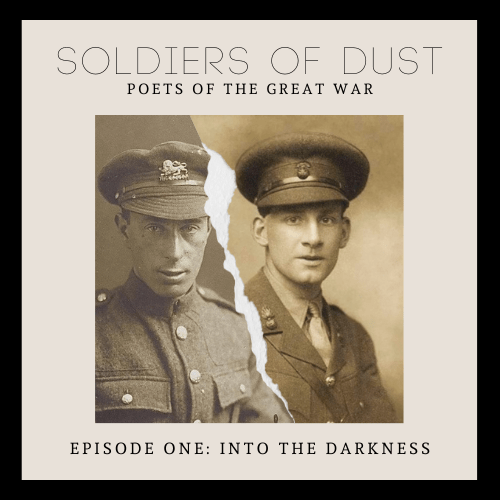
In our first episode, we will be covering Siegfried Sassoon, one of the most well-known poets., And another poet. Isaac Rosenberg, who while,not as well known, is equally [00:03:00] important. The two of them have not much in common aside from being poets in the first world war, but the one thing that does link them as if they were both Jewish.
While Siegfried’s heritage was obscured by assimilation into British culture. Isaac was the son of Jewish immigrants. And as opposed to Siegfried’s’ rich athleticism. Isaac was perpetually judged as not fit to be a soldier. He was too small and too frail to ever look the part. Both men have left an important mark for British Jews and for poetry. We will discuss their lives, their experiences with the war, and their legacies.
Siegfried Loraine Sassoon was born on the 8th of September, 1886, in Matfield, Kent. His parents were Alfred Ezra Sassoon, son of a Sephardic Jewish merchant dynasty, and Theresa Thornycroft, who was part of a family of successful artists. As the Sassoon family was Orthodox, Alfred was required to marry a Jewish woman, as under Jewish law., the bloodline is passed by the mother. Unfortunately, Theresa was Catholic and so Alfred was disowned by his family and written out of his [00:04:00] mother’s will. They had three sons, Michael , Siegfried, and Hamo. The three boys grew up in a ramshackle Victorian called Weirleigh, which had a garden that Siegfried was especially fond of Alfred and Theresa separated in 1890, when Siegfried, was only four years old. The two had had a quick engagement before marrying as Theresa was a few years older and at 34, she felt she couldn’t wait any longer to have children. Alfred had had a reputation as a womanizer before his marriage, and it appeared the idyllic country life and Weirleigh had begun to suffocate him.
His father visited regularly, but the tension was too much between the estranged couple, with Theresa locking herself in the drawing room and Alfred not speaking to her when they interacted. His father died four years later from tuberculosis, which devastated Siegfried and his brothers. The boys lived a rather sheltered life as Theresa employed a professional tutor to educate them at home. Siegfried didn’t go to a traditional school until he was 13 years old, first to a prep school, and then a boarding school in Kent in 1900. Marlboro college was far enough away that he began to have a little bit of freedom with the comfort of having his [00:05:00] brothers nearby. He also was able to play cricket and was introduced to golfing- two sports that he would continue to play for the rest of his life. Though he wasn’t an excellent student, he was a visual learner and found it hard to concentrate on things that didn’t interest him. His experience at boarding school and reaching puberty, opened him up to new feelings and he began to realize he was interested in the same sex. However due to strict religious and social conventions. He repressed these feelings and maintained his focus on sports and studying. In addition to homosexual acts, being outlawed, the trial of Oscar Wilde was still in the public consciousness. Marlboro effectively policed the boys from any kind of sexual exploration by ensuring there were no locks in the lavatories. And essentially told them that if they participated in masturbation, that their genitals would fall off. The school did however, foster Siegfried’s love of poetry, which had the gun when he was young., And he would participate in writing competitions at school. His love of late romantic period poetry continued to influence this work. In 1905, he began university at Clare college at Cambridge, studying history and self published his first volume of poetry the following [00:06:00] year. His time at Cambridge only lasted two years before he returned home to Weirleigh. As his mother’s favorite, Theresa was happy to have her son back and Siegfried assumed the role of country gentlemen. He played golf in the spring and autumn, played cricket in the summer and Fox hunted in the winter. He was an excellent horseman, a passion he shared with his mother. Despite being introduced to eligible women at balls and socials. He wasn’t interested in a heterosexual relationship. He liked women, but in a purely platonic fashion. This became clear after he read The Intermediate Sex by Edward Carpenter. The book was published in 1908 and served as an expression of Carpenter’s views of homosexuality and a concentrated effort to provide a sympathetic view of same-sex desire. It may have also helped that secrets, younger brother, Hamo was also gay or as they affectionately referred to him. “hamo-sexual”. In 1911, his friendship in correspondence with the Carpenter had allowed him more confidence in himself and his work. His first published success came in 1913, a parody of John Masefield’s poem, The Everlasting Mercy called “The Daffodil Murder”. [00:07:00] Following on from his success, he became friends with Edward Marsh on a trip to London. Marsh was a classical scholar and had published a volume of Georgian poetry the year before. Marsh encouraged him to move to London and offered him connections in the literary world. Siegfried felt ready to fly the nest London and devote himself to poetry. Over the summer of 1914, he also met fellow poet, Rupert Brooke. Though their meeting did not go well as Siegfried felt inadequate next to Brooke’s success. He was at a crossroads at this point. He spent too much money while in London and had a taste of freedom from his mother and life in the country. As the war broke out in the fall of 1914, Siegfried, saw the chance to find purpose in his life.
Isaac Rosenberg was born to Orthodox Jewish parents, Barnett and Anna Rosenberg, in Bristol on the 25th of November, 1890. He was the younger of twins, but the only one to survive the birth. His parents and older sister, Minnie, emigrated from Dvinsk in what is now known as Latvia to Bristol, England, before he was born.
Barnett worked as a door to door salesman and was gone for six months a year leaving Anna to make ends meet by taking in [00:08:00] lodgers, doing the neighbors washing, and selling embroidery. As the eldest son, Isaac became the head of the household in the Jewish tradition while his father was awayand this fostered a close relationship between Isaac and his mother. The family moved to London in 1897 when he was six, but life in London wasn’t much easier for the Rosenbergs with cramped surroundings in a smoke covered city.
I also had four younger siblings, two sisters, Annie and Ray and two brothers, Dave and Elkon. They looked up to their older brother and admired him.
Barnett and Anna’s relationship was fraught with tension. Anna was resourceful with her family at the forefront of her mind. She planted vegetablesl, tended a garden behind the tenement houses they lived in. She taught herself English. Barnett was an aspiring scholar and a dreamer, putting them at odds with each other. The relationship continued to deteriorate until they barely spoke to one another, causing tension for Isaac and his siblings.
At age 11, he started painting with watercolors and had made it known that he wanted to be an artist. Anna had been providing dress making and embroidery to rich Jewish women, which gave her connections to both ask for advice and show off Isaac’s work.
[00:09:00] Anna’s efforts helped her procure Isaac, a place at an art school one day a week at Stepney Green craft school by a kind patron at age 12. While,the program was vocational based, it was the first time that Isaac was able to be with other children who were also interested in art and of a similar background.
While Isaac was bright yet shy with a talent for poetry and art, university was not an option for him. Shortly after turning 14, Isaac was forced to leave school and enter the job market. 14 was the school leaving age for working class children and Isaac was needed to help provide for the family. He began work as an engraving apprentice, which he disliked, and he spent his meal breaks, writing poetry.
His dream was to become a painter and so he took classes in the evening at Birkbeck college, which buoyed his confidence and enabled him to win prizes for his art. He withdrew from his apprenticeship when he was just shy of age 21, when he was sponsored to attend Slade school of fine art in October 1911.
Going to Slade opened doors for Isaac, but it also made him feel out of place. He had talent, but so did everyone, and being both a poet and a painter wasn’t unusual. [00:10:00] While he was confident in his work, he was extremely uncomfortable with the social aspects, which caused tension with his benefactors. He applied for the Jewish Educational Aid Society, which paid for the next two years of art school, allowing him some freedom. He also published a pamphlet of a selection of his poems called, night and day. In a turn of fate, Isaac was introduced to Edward Marsh.who bought one of Isaac’s paintings and hung it in the guest bedroom of his flat. Marsh was impressed by Isaac’s talent and became an editor for Isaac’s poetry. By 1914, Isaac’s interest had drifted away from art to poetry, and he chose to leave Slade a term early. His health had also deteriorated, and he was experiencing a crisis of what to do with his life. He left London to visit his sister, Minnie, who had immigrated to South Africa, with her husband. Isaac was welcomed into the local art community in Cape Town, experienced a more relaxed pace of life, and the weather helped his lungs improved. It was while he was in South Africa, that war was declared. Isaac, wrote a poem about the experience. “On receiving the first news of the war.”
Mat: Snow is a strange white word, no ice or [00:11:00] frost, as asked of bud or bird, for winter’s cost, yet iced and frost and snow from earth to sky, this summer land doth know, no man knows why, in all men’s hearts it is, some spirit old, hath turned with malign kiss our lives to mould. Red fangs have torn his face.
God’s blood is shed. He mourns from his lone place, his children dead. Oh crimson curse, corrode, consume. Give back this universe, its pristine bloom.
Ashton: Siegfried joined the service just a few days before Great Britain declared war on Germany on the 4th of August, 1914. He signed up as a trooper with a Royal Sussex Yeomanry, but after an accident in the field, he was forced to return home to recuperate with a broken arm. During his convalescence at Weirleigh, he began writing poetry again, which reinvigorated his passion for it. By February 1915, his arm had healed and he applied to enter as a second Lieutenant with the Royal [00:12:00] Welch Fusiliers it felt it was the correct thing to do after his less than successful experience as a cavalry trooper. He joined the third battalion of the Royal Welch Fusiliers and headed off to Litherland near Liverpool to begin his training. At first, Sassoon felt like a fraud as he had no experience of leading or being an officer. He was also unsure of his being 28 years old and in charge of men who had an average age of 21. But it worked in his favor as, he was able to understand and relate to them due to his lack of life experience. The men were looking forward to going to the front and fighting to prove themselves as soldiers. It was during this time that says soon was assigned a new roommate in the barracks with whom he bonded. David Cuthbert Thomas was 10 years, his junior of a similar middle-class background and rank. He’d recently graduated from Royal Military Academy Sandhurst.
The two cemented their friendship during a training course in Cambridge in the summer of 1915. They shared a love of sports and Sassoon introduced Thomas to poetry and regaled him with stories of Fox hunting. While, Thomas was heterosexual. Siegfried had a deep love for him, even if he was unable to physically [00:13:00] express his affection or speak about it. Sassoon was still in Cambridge, when he learned of his younger brother, Hamo’s death aboard a hospital ship in Gallipoli.on November, 1915. The weight of this loss would not sink in until later and it contributed to the turn as poetry took from idealistic to embittered. Shortly after his brother’s death Sassoon was stationed with the first battalion of the Royal WelshFusiliers in France where he met Robert Graves, another poet. The two were both from middle-class backgrounds and both were attracted to men. We will cover. Robert Graves in the next episode, but suffice it to say becoming friends with Graves’ both inspired him creatively and provided him with a confidant who understood what it was like to be queer and closeted. Unlike other ranking officials Sassoon was very focused on being a good leader and was concerned with the conditions of his comrades. He described them as a family, despite the horrors of the trenches. The final blow to his idealism came in March, 1916 when Thomas was killed by a shot to the throat. while reaching for a letter in his pocket from his girlfriend. The weight of grief came crashing down onto Sassoon and resulting in him earning a reputation of a [00:14:00] Daredevil. He became obsessed with hurting the enemy and led patrols in no man’s land. He risked his life to rescue a wounded man, who was lying disabled in a shell crater during enemy fire, which resulted in him being recommended for a military cross.
After he contracted Trench fever, a disease transmitted by infected lice bites. He was sent home to Somerville College at Oxford to recuperate. Graves was also working from an injury. Graves was also recovering from an injury and the two spent time together working on their poems. At this point, Sassoon spared, no one in his poetry and his grief and anger had turned to rage, the intense loss of life and the futility of war. He contemplated making a stand against the war, but this was complicated by his being an officer where he could be jailed or at worst shot for his insubordination. While he convalesced, in England, his comrades were fighting in the battle of the Somme, the largest loss of life in the war.
In November, 1916, he wrote “the poet as hero” a brutal poem using Arthurian legend to explain the loss of innocence he had experienced.
Mat: You’ve heard me, scornful, harsh, and [00:15:00] discontented, mocking and loathing war. You’ve asked me why, of my old silly sweetness, I’ve repented, my excess changed to an ugly cry. You are aware that I once sought the grail, riding in armor bright, serene, and strong, and it was told through my infant wail there rose immortal semblances of song.
But now I’ve said goodbye to Galahad, and am no more the knight of dreams and show. For lust and censor’s hatred make me glad, And my killed friends are with me where I go. Wound for red wound I burn to smite their wrongs, And there is absolution in my songs.
Ashton: By saying goodbye to Galahad the legendary of the round table, Sassoon had left behind his idealism when he first entered the war. He had suffered so much loss and had seen people be destroyed, by what was supposed to be an adventure. Despite being deemed fit for service Sassoon was not sent back to France until February 1917. His disillusionment gave way to resuming his role as a leader [00:16:00] for his brothers in arms. His regiment returned to the front in April when the battle of Arras was underway and had become a blood bath. While advancing on some Germans Sassoon was shot by a sniper through his right shoulder with the bullet missing his jugular and spine by a fraction of an inch.
The injury was a sign at both his recklessness and bravery. And nearly got him killed. He eventually was shipped back to England to recover from his wounds.
Isaac Rosenberg returned to England in March, 1915 from Cape Town. While he was invigorated after his time away. England was still the same. He returned home to live with his family as the tension between his parents in they’re cramped, flat persisted. He continued writing and trying to get his poems published and went back to school to learn the printing trade. However enlisting was looking more and more like a practical decision for him. He was barely making any money and was another mouth to feed for his parents. There was also a large amount of external pressure for young able-bodied men to be enlisted and those who were seen without a uniform were sometimes targeted in the streets. The work continued to drag on and by Autumn 1915. [00:17:00] Rosenberg had ran out of options. He nearly failed his medical due to his weak lungs, but the army was desperate for young men. He joined the Banton battalion and was shipped to an army recruit Depot in bury St. Edmunds. Not wanting to upset his parents, he sent them a letter letting them know that he had joined after arriving. While, his parents were distraught and confused by his choice, he’d been left without one. His time in the army unlike Sassoon’s was miserable. He had nothing in common with this fellow recruits and spent his spare time reading and writing poetry, which made him seem even more of an outlier. He was also the only jewish person in the barracks, leaving them to feel even more isolated. Rosenberg wasn’t particularly religious and had lost any real interest while he was a teenager, but he was instinctively safe at home in the east end amongst his own people. He was ill-equipped for the physical labor of coal digging and he suffered from blisters on his feet due to his boots. His was only respite was receiving packages from family and friends with treats, paper, watercolors, and cigarettes. He was able to use some of these items to receive better treatment from his fellow soldiers. Once he received his uniform and [00:18:00] his rifle, he began to feel more like a soldier. He was transferred to another regiment, King’s Own Royal Lancasters which proved a better fit for ,him.but though it was still a miserable experience. In spring 1916, he was able to self publish his verse play Moses, and a few poems of his own. His battalion continued to train in preparation for heading to the front and they arrived in June. Rosenberg continued to write poems and draw, but could only use the supplies he had on hand, which were scraps of paper and pencil crouched over a campfire. His poetry was mired in realism, illustrating the mundanity of life and the trenches and moments of terror. There were no illusions of glory or seething hot rage. It simply was what it was.
Isaac sent his poems to a sister, Annie who typed them up and return them back for corrections and changes. Annie also continued to try and convince Edward Marsh to. Get his friends in the war office to have Isaac be declared unfit for service., But despite being examined several times, it didn’t work. Unfortunately for Isaac, he did not fit in as a soldier. So he was transferred [00:19:00] multiple times. As Michael Korda describes it.” Nobody disputed his bravery or his willingness to work hard. But he never managed the indispensable trick of looking like a soldier that is so dear to the heart of every Sergeant- major.” Fact is Isaac was just another body in the trenches, another the soldier in the war. On May, 1917, he found inspiration, in the larks singing at dawn when he would return from taking supplies up the line. And wrote “returning we hear the larks.”:
Mat: Somber the night is, and though we have our lives, we know what sinister threat lurks there. Dragging these anguished limbs, we only know this poisoned, blasted track opens on our camp, on our little safe sleep. But hark! Joy! Joy! Strange joy! Low heights of night, ringing with unseen larks. Music sharing our upturned listening faces.
Death could drop from the dark as easily as song. The song only dropped. Like a blind man’s dreams on the sand by dangerous tides. Like a [00:20:00] girl’s dark hair, for she dreams no ruin lies there. Or her kisses where a serpent hides.
Poem takes inspiration from, to a Skylark by Percy Shelley, and instead use it to highlight the dangers of war amongst the beauty of nature. Isaac was able to get two weeks leave. Where he saw his family briefly before returning to France, his health continued to deteriorate.
And by the autumn of 1917, he had caught influenza and was hospitalized. Despite Annie’s continued efforts. Isaac was continually passed off as fit for service despite his lungs. Annie tried to convince Edward Marsh to get him a desk job somewhere, but young men were needed on the front lines.
SIegfried Sassoon was denied any further commendations after his act of bravery, when he was injured, which angered him. Instead he was continually disillusioned with the war and those in charge and he decided to take a stand. His next collection of poetry, the old Huntsman was published in May, 1917. While it was a success, his biting, war poems did not have the effect that he [00:21:00] wanted. Despite being offered a post at Cambridge as a cadet training officer, Siegfried wrote a letter to his commanding officer explaining that he would not be performing his duties in protest. And then made a public statement, declaring his opposition to the war. Instead of being arrested, he was ordered to appear before medical board to assess his health. Ultimately Robert Graves defended him to the board explaining that his friend was suffering from “shell shock” or what we now call post-traumatic stress disorder. Graves had pointed out that if he did not acquiesce to the board’s demands, they would commit Siegrfried to a mental hospital for the duration of the war. Siegfried Sassoon was above all things and officer and a gentleman and so he agreed to be treated at a convalescent home for officers. Sassoon was sent to Craig lockhart war hospital, an old hydropathic Victorian hospital located outside Edinburgh in July 1917. The as a strange waiting room for the mentally unfit, where once they were some semblance of better they would be shipped back to the front lines. Siegfried stayed at the hospital for four months. Where he became friends with a fellow poet, Wilfred Owen. Wilfred Owen will be [00:22:00] covered in our next episode, but. the two encouraged each other to write and the work they produced to some of the most iconic war poetry.
Mat: Soldiers are citizens of death’s grey land, drawing no dividend from time’s tomorrows. In the great hour of destiny they stand, each with feuds and jealousies and sorrows. Soldiers are sworn to action, they must win some flaming fatal climax with their lives. Soldiers are dreamers, when the guns begin they think of violet homes, clean beds and wives.
I see them in foul dugouts, gnawed by rats, and in the ruined trenches lashed with rain, dreaming of things they did with balls and bats, and mocked by hopeless longing to regain. Bank holidays and picture shows and spats, and going to the office in the train.
Ashton: Dreamers recalls the mundanity of life as wished for, by soldiers in the trenches, or even the men who were in the hospital caught between what they experienced and what they were going through. [00:23:00] After four months it crack lock war. Greg Lockhart war hospital secret soon was released and returned to the RWJF Depot in Liberland. He was able to fit right back into the army life again, and was glad to be amongst his comrades. Love that they shared for each other.
It was fierce and true. He was in posted to the 25th battalion in Palestine before being moved to France. While on patrol in the early hours, he was mistakenly hit by friendly fire from his own frontline. We’d sit up to stretch and took his helmet off. And the bullet had resulted of a terrible gash. Infection set in and he was sent back to England for the final time.
Isaac Rosenberg was moved again to the first battalion of King’s own Royal Lancaster regimen, which was staged, which was stationed in Aras. He had hoped to join an all Jewish regimen that was stationed in the middle east, where the dry climate would be better for his lungs. Sent a letter to Edward Marsh dated the 28th of March, 1918 with an enclosed poem. Through these pale cold days. By the time it arrived, he had been killed in action.
Mat: Through these pale cold days, [00:24:00] What dark faces burn, Out of three thousand years, Their wild eyes yearn. What underneath their brows, Like waves their spirits grope, For the pool of Hebron again, For Lebanon’s summer slope. They leave these blonde still days, In dust behind their tread, They see with living eyes, How long they have been dead.
Ashton: OnI’m March 31st, 1918 Isaac and his platoon were sent out to patrol no man’s land when they were attacked by a German raiding party. Isaac and five of his other soldiers were killed possibly by an explosion and buried in a mass grave. He was 27 years old. His gravestone was placed in 1926 with a star of David and the words, ” . ARtist and poet.” . His sister, Annie continued to fight for her brother’s legacy until she died. She [00:25:00] died..
After the war Siegfried relinquished his position in the army for health reasons and became more involved in politics. He wrote speeches and was an ardent labor party supporter. In 1919, he became a literary editor for the daily Herald liberal newspaper. He had several relationships, men, including a seven year relationship with Stephen, Tennant and aristocrat. In 1933, shortly after tenant broke things off, you met his future wife had Hester Gatty despite the 20 year age difference the two married later that year and had a son named George though. They separated in 1945. He died of stomach cancer in 1967, just shy of 81 years old.
As we’ve discussed Sassoon and Rosenberg’s legacies involve the war, but they were undisputedly talented without it. They went into darkness of their trauma and pain and found a way to communicate it to others. So I stayed with us through the past a hundred years and welfare, many more. It’s the legacy of Judaism in a way, continuing to survive [00:26:00] despite hardship and suffering for centuries. It’s the spirit of continuing on it, but it’s everything else capturing a moment of hurt or happiness and putting it down onto paper. And so we conclude our episode with the recitation of “Everyone Sang by Siegfried Sassoon
Mat: everybody suddenly burst out singing, And I was filled with such delight, As prison birds must find in freedom, Winging wildly across the white orchards And dark green fields, On, on and out of sight. Everyone’s voice was suddenly lifted, And beauty came like the setting sun, My heart was shaken with tears, And horror drifted away, Oh, but everyone was a bird, And the song was wordless, The singing will never be done.
Ashton: Thank you for listening to this episode of soldiers of dust. You can find sources, transcripts, and contact information on my website, the magpie historian.com. Special thank you to Mathew Austin for his reading of both Siegfried Sassoon and Isaac [00:27:00] Rosenberg’s work and as always to my advisor, Dr. Edward Madigan for his support. If you liked the podcast, please let us know by rating and reviewing us on the platform of your choice. We hope you’ll join us again in the future. I’ll see you next time.
[outro music]
 Ashton Kessler
Leave a comment