Sources:
Amaral, Marina, ‘Robert Graves: The Last Chapter’, The Colour of Time with Marina Amaral, 2023 <https://marinaamaral.substack.com/p/robert-graves-the-last-chapter>
———, ‘Wilfred Owen: Echoes from the Trenches’, The Colour of Time with Marina Amaral, 2023 <https://marinaamaral.substack.com/p/wilfred-owen-echoes-from-the-trenches>
Cutherbertson, Guy, WIlfred Owen (Yale University Press, 2015)
Graves, Robert, Goodbye to All That (Jonathan Cape, 1929)
Korda, Michael, ‘How Wilfred Owen and Siegfried Sassoon Forged a Literary and Romantic Bond’, Literary Hub, 2024 <https://lithub.com/how-wilfred-owen-and-siegfried-sassoon-forged-a-literary-and-romantic-bond/>
———, Muse of Fire: World War I as Seen Through the Lives of the Soldier Poets (Liveright, 2024)
‘Robert Graves’ <http://www.robertgraves.org/> [accessed 15 August 2024]
‘Story: Wilfred Owen’s Sexuality | Lives of the First World War’ <https://livesofthefirstworldwar.iwm.org.uk/story/81117>
Transcript:
Will: [00:00:00] Anthem for doomed youth. What passing bells for these who die as cattle? Only the monstrous anger of the guns. Only the stuttering rifles rapid rattle can patter out their hasty orisons. No mockeries now for them. No prayers, nor bells, nor any voice of mourning save the choirs. The shrill, demented choirs of wailing shells, and bugles calling for them from sad shires.
What candles may be held to speed them all? Not in the hands of boys, but in their eyes, shall shine the holy glimmers of goodbyes. The pallor of girls brows shall be their pole, Their flowers the tenderness of patient minds, And [00:01:00] each slow dusk a drawing down of blinds.
Ashton: I’m Ashton Kessler. Also known as The Magpie Historian. I’m a master’s student and public historian. This is Soldiers of Dust, a podcast dedicated to exploring the poetry of the great war. Over the next episodes, we will discuss the poets their work and the way that it shaped how we view the war in the present day.
As we begin our second episode, I would like to remind the listeners that the subject matter may be upsetting and possibly triggering as this podcast is ultimately about the effects and trauma of war. Other themes that we will cover such as anti-semitism classism, sexism, xenophobia, and homophobia can also be a cause for upset. So please be aware of this while listening.
One of our subjects, Wilfred Owen is a name synonymous with poetry of the great war. He accomplished so much in a short amount of time, and we’re still talking about him today. However, as I mentioned, in the introduction of the first episode, there are parts of his life that we don’t [00:02:00]really talk about, and I think it’s important that we do. And the same applies to Robert Graves, a man who was. Perhaps a little more rough around the edges and his poetry and personal life, but he also had a biting wit and immense intellect.
So I hope you’ll join me on this journey.
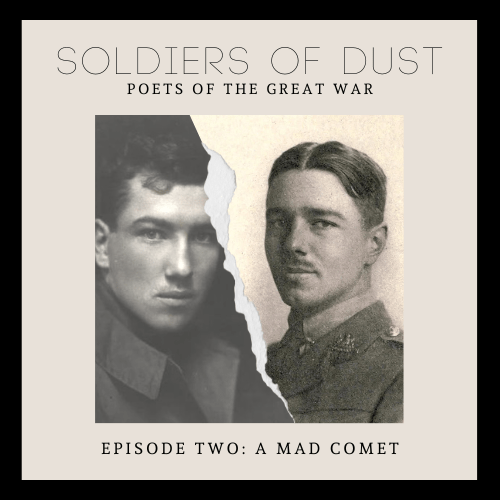
Wilfred Edward Salter Owen was born on the 18th of March, 1893 at Plas Wilmot. a house near Oswestry, Shropshire, England. Wilfred was the oldest of four children. He had one sister Mary and two younger brothers, Harold and Colin. His parents, Thomas and Susan were both god-fearing people who went to church every Sunday and prayed every day. Thomas worked for a railroad company, which left them lower middle-class. The family moved a few times over Wilfred’s childhood as Thomas’ job required before settling in Shrewsbury. Susan was a devoted mother, but Wilfred was her favorite leading him to be quite sheltered by their relationship. Both parents were determined to give their children a good education, but public school and university were out of their means. [00:03:00]Wilfred attended a private school in Birkenhead for lower middle-class children, which would open his options for the future, and then later enrolled in a technical college to prepare for a career in teaching. However, for a bright 18 year old boy with a love of poetry this felt like a dead end. He desperately wanted to attend Oxford, but his family couldn’t afford it. Instead, his mother arranged for him to become an assistant at a small church in Oxfordshire which would allow him to continue studying and go onto university. By becoming a reverend’s assistant, he had his first taste of life away from his family, but it was boring, and he had little time to devote to poetry. Wilfred interest in religion waned and after nearly two years with the Reverend, he was emphatic that he did not want to work in the church. So Wilfred moved back home to his family without a job or a degree- back to square one again at almost 20 years old.
Wilfred started a job teaching English at a Berlitz school in Bordeaux, France. Bertliz was more lenient on qualifications though it was a position with long hours and low pay. It suited Wilfred just fine as he could speak French and was willing to use the Berlitz method to teach. Wilfred headed off to France in [00:04:00] September, 1913 and there he finally experience what it was like to be independent. Though he continued to write home to his mother, he was able to skip church and stay up late writing poetry. By the time that World War One broke out in June 1914, Wilfred was busy working as an English tutor for the Léger family at their villa and the Pyrenees. His clients were Madame Léger, an actress, and her 11 year old daughter, Nénette who adored him and so he was accepted as part of the family.
While he was aware of the social stigma of being a young man in non-uniform his brief interest in volunteering as a stretcher bearer was put to rest by Madame Léger. It was also through Monsieur and Madame Léger that he met Laurent Tailhade, a famous French poet. While the extent of their friendship is unknown, he was another symbol of how far away Wilfred had come from Shrewsbury. After the summer, he returned to Bordeaux and secured several students to teach and was still unconvinced to join the war effort. While, he contemplated returning home, the danger of German submarines sinking boats made it difficult. Instead, he continued to tutor English with a new family and tried to find other [00:05:00] career options, but truthfully, he only wanted to be a poet. After a visit home to England and May 1915, he was beginning to feel that joining the military was becoming unavoidable and so it was growing up. He spent the summer in Bordeaux and when his current tutees were sent back to boarding school in England, he took the opportunity to return home.
Robert von Ranke Graves was born in Wimbledon on the 24th of July, 1895.
He was the eighth of 10 children of Alfred Perceval Graves and Amalie Von Ranke. His father was from Dublin, was a school inspector, poet and Gaelic scholar. His mother, Amalie was Alfred’s second wife and stepmother to Alfred’s five children from his deceased wife before they had five of their own. While his father was busy with work, his mother was attentive and loving. They lived a comfortable existence; he attended several preparatory schools and would spend the summers in Bavaria or Wales. He won a scholarship to Charterhouse, a private boarding school in Surrey in 1909. Robert had a hard time fitting in with his peers, that Charterhouse, he was still naive to the ways of the world and was ill-equipped for dealing with being targeted by the other teenage boys. He was intelligent, talkative and hardworking. The [00:06:00] fact that he was on a scholarship and had little pocket money did not help his popularity. His middle name “von Ranke” singled him out as German, which at the time was heavily looked down upon, especially when someone started a rumor that he was not only German, but Jewish, as well. After he complained to his parents about his treatment and his wish to leave, his parents attempted to intervene with the headmaster, but it further isolated him from his peers. Instead Robert found solace and writing poetry and took up boxing. He developed a crush on another boy when he was 15.
Robert facetiously explained in his autobiography, Goodbye to All-That, “In English preparatory and public schools romance is necessarily homosexual. The opposite sex is despised and treated as something obscene. Many boys never recover from this perversion. For everyone born homosexual, at least 10 permanent pseudo homosexuals are made by the public school system. Nine of these ten honorably chaste and sentimental as I was.
Another key moment for him at Charterhouse was becoming friends with his teacher, George Mallory, who taught him about mountaineering and encouraged his poetry writing. Mallory later died attempting to climb the summit of Mount [00:07:00] Everest in 1924. His crush on his schoolmate and his friendship with Mallory helped him make it through the rest of his time at Charterhouse. A week before the outbreak of the war, Robert left school and prepared to attend St. John’s college, Oxford. The paper suggested the war would be over by Christmas, and so Robert enlisted, if only to delay, going to Oxford. for a little while.
Silvio: Down in the mud I lay, tired out by my long day of five damned days and nights, five sleepless days and nights, dream snatched and set me where the dungeon of despair looms over desolate sea, frowning and threatening me with aspect high and steep, a most malignant keep. My foes that lay within shouted, made a din, hooted and grinned and cried.
Today we’ve killed your pride. Today your ardor ends. We’ve murdered all your friends. We’ve undermined by stealth your happiness and your health. We’ve taken away your hope. Now you may droop and [00:08:00] mope to misery and to death. But with my spear of faith, stout as an oaken rafter, with my round shield of laughter, with my sharp tongue like sword, that speaks a bitter word, I stood beneath the wall, and there defied them all.
The stones they cast I caught, and alchemised with thought in two such lumps of gold as dreaming misers hold. The boiling oil they threw fell in a shower of dew, refreshing me. The spears flew harmless by my ears. Struck quivering in the sod, There, like the prophet’s rod, Put leaves out, took firm root, And bore me instant fruit.
My foes were all astounded, Dumbstricken and confounded, Gaping in a long row, They dared not thrust nor throw. Thus then I climbed a steep buttress, And won the keep, and laughed, And proudly blew my horn. Stand to! Stand to! Wake up, sir! Here’s a new attack! Stand to! Stand [00:09:00] to!
Ashton: Wilfred Owen joined the 28th battalion of the London regiment also known as the artist’s rifles on the 21st of October, 1915. At this point, being a young and able-bodied man meant that service was inevitable and at least his choice of regiment was known for attracting volunteers from public schools and universities which would be the closest thing that Wilfred would experience to Oxford. He spent the next seven months learning drills and training until June 1916, when he was commissioned into the Manchester regiment, he continued writing poetry, but his poems were romantic in nature and not yet what he would be known for. The experience of war and Siegfried Sassoon’s influence or shape him into one of the most well-known poets of the great war. Wilfred was stationed at a camp in Guilford to complete his officer training. He now had two stars on his lapel, as a second Lieutenant, which made him an officer and a gentlemen. At this point, the average life expectancy of a second Lieutenant was six weeks at the front, and they needed a constant stream of them to replace. After spending Christmas with his family, Wilfred went off to France in January 1917. They arrived, to quote poet, Christina Rossetti. In the bleak Midwinter- [00:10:00] it was cold, exhausting and filthy. After traveling several days to the front, things did not much improve. By the next month had been tear gassed, contracted dysentery, and one of his platoon had frozen to death. He would recall this in a poem he wrote later that year, titled “Exposure”.
Will: Exposure. Our brains ache in the merciless iced east winds that knive us. Wearied we keep awake because the night is silent. Low drooping flares confuse our memory of the salient. Worried by silence, sentries whisper curious, nervous, but nothing happens. Watching we hear the mad gusts tugging on the wire like twitching agonies of men among its brambles.
Northward incessantly, the flickering gunnery rumbles. Far off, like a dull rumor of some other war. [00:11:00] What are we doing here? The poignant misery of dawn begins to grow. We only know war lasts, rain soaks, and clouds sag stormy. Dawn massing in the east, her melancholy army attacks once more and ranks on shivering ranks of grey.
But nothing happens. Sudden successive flights of bullets streak the silence, less deadly than the air that shudders black with snow, with side long flowing flakes that flock, pause, and renew. We watch them wandering up and down the wind’s nonchalance, but nothing happens.
Pale flakes with fingering stealth come feeling for our faces. We cringe in holes back on forgotten dreams and stare, snow dazed, deep [00:12:00] into grassier ditches. So we drowse, sun dozed, littered with blossoms, trickling where the blackbird fusses. Is it that we are dying? Slowly our ghosts drag home, glimpsing the sunk fires, gallowsed with their Crusted, dark red jewels.
Crickets jingle there for hours. The innocent mice rejoice. The house is theirs. Shutters and doors all closed. On us the doors are closed. We turn back to our dying. Since we believe not otherwise can kind fires burn. Now ever sun smile true on child or field or fruit. For God’s invincible spring our love is made afraid.
Now ever sun smile true Therefore not loath we lie out here, [00:13:00] Therefore were born, for love of God seems dying. Tonight this frost will fasten on this mud and us, Shriveling many hands and puckering foreheads crisp. The burying party, picks and shovels in shaking grasp, pours over half known faces. All their eyes are ice, but nothing happens.
Ashton: In March, he suffered concussion after falling down a 15 foot abandoned cellar while trying to find one of his men. He’d hit his head on the way down which resulted in his hospitalization for the side effects of his concussion and celebrated his 24th birthday in hospital. He returned to the front, but his head injury was still showing side effects. In April, a heavy German shell exploded only a few feet from him watching him into the air and landing him amongst the body parts of her friend who had been disinterred from a shallow grave by a previous shell. By May,, he was sent to a neurological specialist for a [00:14:00] month due to his behavior- he’d becomes shaky and developed a stammer. His nerves were shot and he was losing his nerve and belief in the war. He wrote to his mother, “I do not for a moment supposed I have had a breakdown. I am simply avoiding one.” He caught trench fever with a high temperature , but his main problem continued to be his nerves. He was shuffled through a few hospitals before eventually being diagnosed with “neurasthenia” or shell shock. He was sent to Craiglockhart War Hospital, outside Edinburgh to recover for three months. In some ways, Craiglockhart was the boarding school experience that Wilfred never had treatment was focused on getting the men out of their own misery by doing exercise and joining activities. Wilfred became the editor of the hospital’s magazine Hydra and founded the field club, which studied the natural environment area around the hospital. He had time to write poetry, which he published in the magazine and attended therapy. In mid-August 1917 Wilfred took the opportunity to bring several copies of The Old Huntsman and called on Siegfried Sassoon, who was also a patient at the hospital. He asked him to sign the books for himself and some friends, and there began a friendship that would change both [00:15:00] men’s lives. Wilfred for was smitten to have a friend of great poet like Sassoon. There was undoubtedly some hero worship as he wrote to his mother, “Last night, he wrote a piece which is the most exquisitely painful war poem of any language or time. I don’t tell him so, or that I’m not worthy to light his pipe.” Wilfred idealized, Sassoon and felt that they were kindred spirits. He had found someone who could understand his love of poetry and encouraged him to pursue it further. He was a father figure in a certain way. The idealized man, that Wilfred wanted to be- a poet and officer and a gentleman. There was no doubting that he was in love with Siegfried, but as same sex relationships were illegal at the time, the outcome was not in their favor.
In October 1917 Wilfred was seen by the medical board who deemed him not fit for general service but fit for clerical duties and he was given three weeks leave. He spent his last evening having dinner with Sassoon in Edinburgh. He gave him a thick envelope as a parting gift inside was a note of introduction to Robert Ross, a friend of Sassoon’s and an editor with excellent literary connections and a 10 pound note. In response, Wilfred wrote a letter to Sassoon of gratitude, [00:16:00] Know that since mid September, when you still regard me as a tiresome little knocker on your door, I held you as Keats and Christ and Elijah, and my Colonel and my father-confessor, Amenophis IV in profile. What’s that mathematically? In effect it is this: that I love you. dispassionately, so much, so very much, dear fellow that blasting little smile you wear in reading this can’t hurt me in the least. If you consider that the above names have severally done for me, you will know what you were doing. And you have fixed my life- however, short. You did not light me. I was already a mad comet; but you have fixed me. I spun around you a satellite for a month, but I shall swing out soon a dark star in the orbit where you will blaze. He ended the letter with, we loved each other as no men love for long.
Robert Graves joined the Royal Welsh Fusiliers a week after Britain had declared war in 1914. Despite his lack of experience Graves’ was appointed a second Lieutenant as most public school boys were. He [00:17:00] wasn’t the ideal soldier and his lack of finesse for the finer points of army life kept him from going to the front- his shirt was from the wrong tailor, the wrong shade, his boots were not shined properly.
However, he won favor by winning in a boxing match, by proving his sportsmanship and was shipped out to France in early 1915. What he lacked in attention to details, he made up in courage and fearlessness. Amongst the mud and muck, Graves was dedicated to his regimen and it kept him going, in addition to a dark sense of humor. It was the only way to survive such dire circumstances where death was lurking around every corner. During the battle of Loos, gas was used for the first time, but it failed spectacularly leaving over 50,000 British casualties overall. Graves drank a bottle of whiskey a day to handle the trauma and stress.
Robert was promoted to Captain the fall of 1915. When he visited another company’s tent, he stumbled upon a book titled The Essays of Lionel Johnson. Johnson had been a friend of Oscar Wilde’s and a charming, homosexual alcoholic. Grave sought out the owner of the book who turned out to be Siegfried Sassoon, despite the difference in their presentation- Siegfried neatly pressed and [00:18:00]mannered while Graves was outspoken and clumsy. The two bonded instantly over poetry and literature. Graves showed him a few poems that were gonna be printed in his first collection of poetry, Over the Brazier and Sassoon returned the favor. However Graves’ commented that he would soon change his style after being in the trenches.
Speaker 5: When I’m killed, don’t think of me buried there in Cambrinwood, Nor as in Zion think of me with the intolerable good, And there’s one thing that I know well, I’m damned if I’ll be damned to hell. So when I’m killed, don’t wait for me, walking the dim corridor, In heaven or hell, don’t wait for me, Or you must wait forevermore, You’ll find me buried, living dead, In these verses that you’ve read.
So when I’m killed, don’t mourn for me, Shot, poor lad, so bold and young, Killed and gone, don’t mourn for me. On your lips my life is hung. O friends and lovers, you can save your playfellow from the [00:19:00] grave.
Ashton: Just before his 21st birthday Graves was injured in July 1916 when shell splinters hit him over his eye, in the groin, split a finger and pierced a lung. He was taken down to a dressing station where the medical officer thought he would not make it and so his family was informed of his death in combat. However the next day, he was found on a stretcher screaming in pain and was taken to the nearest hospital and then sent to England. He wrote about the experience of dying in his poem, “Escape”.
Silvio: August 6th, 1916. Officer previously reported died of wounds, now reported wounded. Graves, captain, ah, Royal Welsh Fusiliers. But I was dead. An hour or more. I awoke when I’d already passed the door that Cerberus guards, and halfway down the road to Leith, as an old Greek signpost showed, above me, on my stretcher swinging by, I saw new stars in the subterrene sky.
A cross, a rose in bloom, a [00:20:00] cage with bars, An abarbed arrow feathered in fine stars, I felt the vapours of forgetfulness float in my nostrils. Oh, may heaven bless, dear Lady Prosopy, who saw me wake, and stooping over me, for Henna’s sake, cleared my poor buzzing head and sent me back, breathless, with a leaping heart along the track, after me roared and clattered angry hosts of demons, heroes, and policemen ghosts.
Life, life, I can’t be dead, I won’t be dead, Damned if I’ll die for anyone, I said. Cerberus stands and grins above me now, Wearing three heads, lion and lynx and sow. Quick, a revolver! But my Webley’s gone, Stolen, no bombs, no knife, the crowd swarms on. Bellows, hurled stones, not even a honeyed sop, Nothing, good Cerberus, good dog, but stop.
Stay, a great luminous I do believe there’s still some more fear that I brought on leave. Then swiftly [00:21:00] Cerberus wide mouths I cram with army biscuit smeared with ration jam, and sleep lurks in the luscious plum and apple. He crunches, swallows, stiffens, seems to grapple with an all powerful poppy. Then a snore, a crash.
The beast blocks up the corridor with a monstrous hairy carcass, red and done. Too late, for I’ve sped through. O life, O sun.
Ashton: After a brief convalescence, he went back to France, but caught bronchitis and was deemed unfit for service. He was then taken to Somerville College at Oxford, which had been converted into a hospital. It was the last time that Graves would see combat. After Siegfried Sassoon wrote his declaration of protest against the war in July 1917. Graves convinced the medical board to let him speak on behalf as a friend of the patient, he was able to convince them that Siegfried was suffering from nerves and hallucinations. The fact is they were both suffering from post traumatic stress disorder, but at least this would save Siegfried from a court martial. As he left the room, the examining psychologist told him, “Young [00:22:00] man, you ought to be before this board yourself.” Graves was deemed fit for service but at home. And so he took up training cadets. In mid-October graves came to visit Siegfried Sassoon at Craiglockhart War Hospital and met Wilfred Owen. Owen wrote of Sassoon showing Graves one of his poems saying, “It seems Graves’ was mightily impressed and considered me a kind of find! No thanks, Captain Graves! I’ll find myself in due time.” Despite his protestations, he continued to send Graves poems from France after he would turn to the front. Robert had also begun writing letters to Nancy Nicholson, the sister of a friend, and the two married in January 1918 when Nancy was 18 and he was 22. His army career ended after he was posted to Limerick in late 1918. He developed symptoms of Spanish influenza. He returned to London and luckily met a demobilization officer who filled out the paperwork, enabling him to be free.
After being discharged from Craiglockhart, Wilfred Owen was sent a Scarborough, Yorkshire, where he spent the winter writing poetry and doing light regimental duties. He had begun to [00:23:00]receive recognition for his poetry and had won a prize for one of his poems. He was isolated from his own comrades, but he craved friendship. This was echoed in his poem, “Strange Meeting”, which he wrote in early 1918.
Will: Strange meeting. It seemed that out of battle I escaped down some profound, dull tunnel, long since scooped through granites which titanic wars had groined. Yet also there encumbered sleepers groaned, too fast in thought or death to be bestirred. Then as I probed them, one sprang up and stared with piteous recognition in fixed eyes, lifting distressful hands as if to bless.
And by his smile I knew that sullen hall. By his dead smile I knew we stood in hell. With a thousand fears, that vision’s [00:24:00] face was grained, yet no blood reached there from the upper ground. Transcription And no guns thumped, or down the flues made moan. Strange friend, I said, here is no cause to mourn. None, said that other, save the undone years, the hopelessness.
Whatever hope is yours was my life also. I went hunting wild after the wildest beauty in the world. Which lies not calm in eyes or braided hair. But mocks the steady running of the hour, And if it grieves, grieves richlier than here. For by my glee might many men have laughed, And of my weeping something had been left, Which must die now.
I mean the truth untold, the pity of war, The pity war distilled. Now men will go content with what we spoiled, Or [00:25:00] discontent, boil bloody, and be spilled. They will be swift with swiftness of the tigress. None will break ranks, though nations trek from progress. Courage was mine and I had mystery. Wisdom was mine and I had mastery.
To miss the march of this retreating world into vain citadels that are not walled.
Then when much blood had clogged their chariot wheels, I would go up and wash them from sweet wells. Even with truths that lie too deep for taint, I would have poured my spirit without stint. But not through wounds, not in the cess of war. Foreheads of men have bled where no wounds were. I am the enemy you killed, my friend.
I knew you in this dark, [00:26:00] for you so frowned yesterday through me as you jabbed and killed. I parried but my hands were loath and cold. Let us sleep now.
Ashton: Even though he was no longer at the front, he was still haunted by what he had seen, the people he had killed and the person he had been. It was still calling to him in some way. In the spring, he was sent to Ripon to train to go back to the front. Despite his reservations to return the stigma of being shell shocked or losing his “nerve” hung over him. To go back and fight would mean he would prove himself and to be with his fellow soldiers. He saw Siegfried Sassoon one final time after he’d been injured and sent back to England. Siegfried threatened to stab him in the leg if he returned to the trenches, but there was no other choice for Wilfred. Instead he quietly returned to active service and wrote a letter from France, advising him to not bother buying a dagger for said, stabbing. At the end of September, Wilfred’s battalion took part in an offensive for the Allies which won him the Military Cross. The war was coming to an end, but the Germans had not yet surrendered. Exactly one week before armistice was [00:27:00] declared, Wilfred Owen was killed in action on November 4th, 1918. He was 25 years old. He received Lieutenant status the very next day.
Robert Graves’ returned to Oxford to study in October 19 19. He and Nancy had four children and Robert published numerous books, but none that were particularly successful. In 1926, he took a job as an English professor at Cairo University though it only lasted two terms before he returned to England. He and Nancy met an American poet, Laura Riding who joined the relationship and in ménage à trois. Laura fell in love with an Irish poet named Geoffrey Phibbs who was then added into the already existing relationship. In April, 1929, Laura attempted suicide in a fit of jealousy by jumping out a window, with Robert following after her. This proved to be the final straw and Nancy and Robert formerly separated the following month. Robert and Laura immigrated to Spain and later that year Robert’s autobiography, Goodbye to All-That was published. It became an enormous success. As the Spanish civil war broke out robert and Laura moved between England, Switzerland, and France. [00:28:00] In 1939, Laura left Robert for another man, while, he began a relationship with his friend, Beryl Hodge. They had four children together and eventually settled in Spain. He continued to write and gained international recognition. He died peacefully on the 7th of December, 1985 at age 90 in Majorca.
There is something quite beautiful in the way that Graves and Owen write about war. It’s dirty and brutal but they make it their own.- In a way that’s just transcendent. It’s that kind of legacy that encourages us to read it and understand. The cruelty of what they experienced.
It’s also. I think the comradery they had with one another. Not necessarily in a queer way, but in the way that they have a brotherhood. Something that’s eternal.
Ashton: And on that note, I leave you with a recitation of one of Wilfred Owen’s, most famous poems:
Will: dulce et decorum est. Bent double like old beggars under sacks, knock kneed, coughing like hags we [00:29:00] cursed through sludge, till on the haunting flares we turned our backs, and towards our distant rest began to trudge. Men marched asleep. Men had lost their boots, but limped on, bloodshot. All went lame, all blind.
Drunk with fatigue, deaf even to the hoots of gas shells dropping softly behind. Gas! Gas! Quick, boys! An ecstasy of fumbling fitting the clumsy helmets just in time. But someone still was yelling out and stumbling and floundering like a man in fire or lime, dim through the misty panes and thick green light, as under a green sea I saw him drowning.
In all my dreams before my helpless sight he plunges at me, guttering, choking, drowning. If in some [00:30:00] smothering dreams you too could pace behind the wagon that we flung him in and watch the white eyes writhing in his face, his hanging face, like a devil sick of sin. If you could hear at every jolt, the blood come gargling from the froth corrupted lungs, obscene as cancer, bitter as the cud of vile, incurable sores on innocent tongues.
My friend, you would not tell, with such high zest, to children ardent for some desperate glory, the old lie. Dulce et decorum est pro Patamori.
Thank you for listening to this episode of Soldiers of Dust, you can find sources, transcripts, and contact information on my website, the magpie historian.com. Special thank you to Silvio [00:31:00]Conte and Will Overend for reading Robert Graves and Wilfred Owen’s poetry this episode. And as always to my advisor, Dr. Edward Madigan, for his support. If you like the podcast, please let us know by rating and reviewing us in the platform of your choice. We hope you’ll join us again in the future. I’ll see you next time.
[outro music]
 Ashton Kessler
Leave a comment